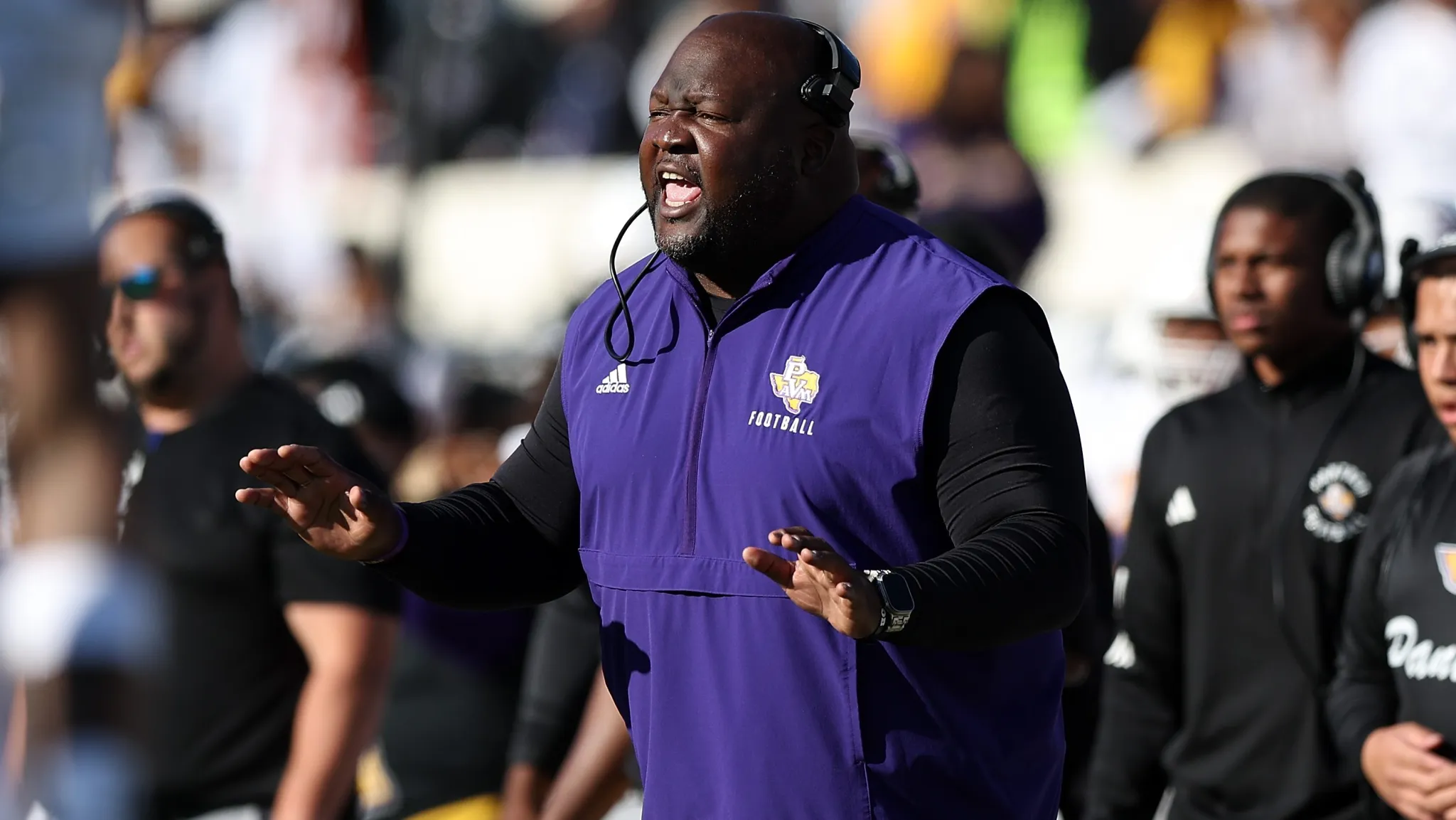

Delaware State head coach DeSean Jackson is challenging one of college football’s oldest assumptions: that the best coaches have to live at the office.
Jackson recently explained that he typically starts his workday early and leaves for the day at around 2 p.m.
For a profession notorious for marathon workdays, late-night film sessions and coaches spending virtually every waking hour inside their football facilities, Jackson’s schedule stands out.
And naturally, it raises a question:
Does spending more hours at the facility automatically make someone a better coach?
WHAT WE KNOW
- DeSean Jackson is the head coach at Delaware State.
- Jackson has spoken publicly about leaving for the day at approximately 2 p.m.
- His approach contrasts with the traditional college football coaching culture of extremely long workdays.
- Jackson became Delaware State’s head coach after a decorated NFL playing career.
- The conversation comes as college football continues to grapple with the demands placed on coaches, players and staff.
The 2 p.m. departure time doesn’t, by itself, tell us how many hours Jackson works, what happens after he leaves the facility or how he structures his responsibilities outside the building.
But it does provide an interesting look at how one head coach approaches his job.
THE BIGGER HBCU FOOTBALL CONVERSATION
College football has long celebrated the coach who arrives before sunrise and leaves after midnight.
But is that necessarily the best model?
Modern head coaches have staffs, analysts, recruiting personnel, technology and communication tools that allow work to continue without everyone physically sitting in the same building.
Jackson’s approach raises a legitimate question about whether productivity should be measured by hours in the building—or by what actually gets accomplished.
That’s especially relevant in HBCU football, where programs often operate with different financial, staffing and resource realities than their Power Four counterparts.
WHO’S RIGHT?
The traditional approach:
Football is an all-consuming profession. Recruiting never stops, opponents require constant preparation and successful programs demand tremendous commitment.
Jackson’s approach:
Long hours don’t automatically equal better results. A coach can structure his day efficiently, delegate responsibilities and still make time for life outside football.
Neither philosophy can be proven simply by looking at a clock.
The more important question may be:
Are the players prepared, is the program organized and is the team improving?
That’s where Jackson’s coaching record—not his departure time—ultimately provides the measurable evidence.
SNEAKER SHOP TALK QUESTION
Would you be comfortable with your college football head coach leaving the facility at 2 p.m. if the program was prepared and winning?
Or should a head coach’s job require being available at the facility deep into the evening?